Hammam
Ṭahāra — purification. Before it is a place of rest, the hammam is, in the Muslim house, an annexe of the prayer: one washes there in order to present oneself pure. At the Riad it holds its place beside the workshop and the prayer room, with the same sobriety.
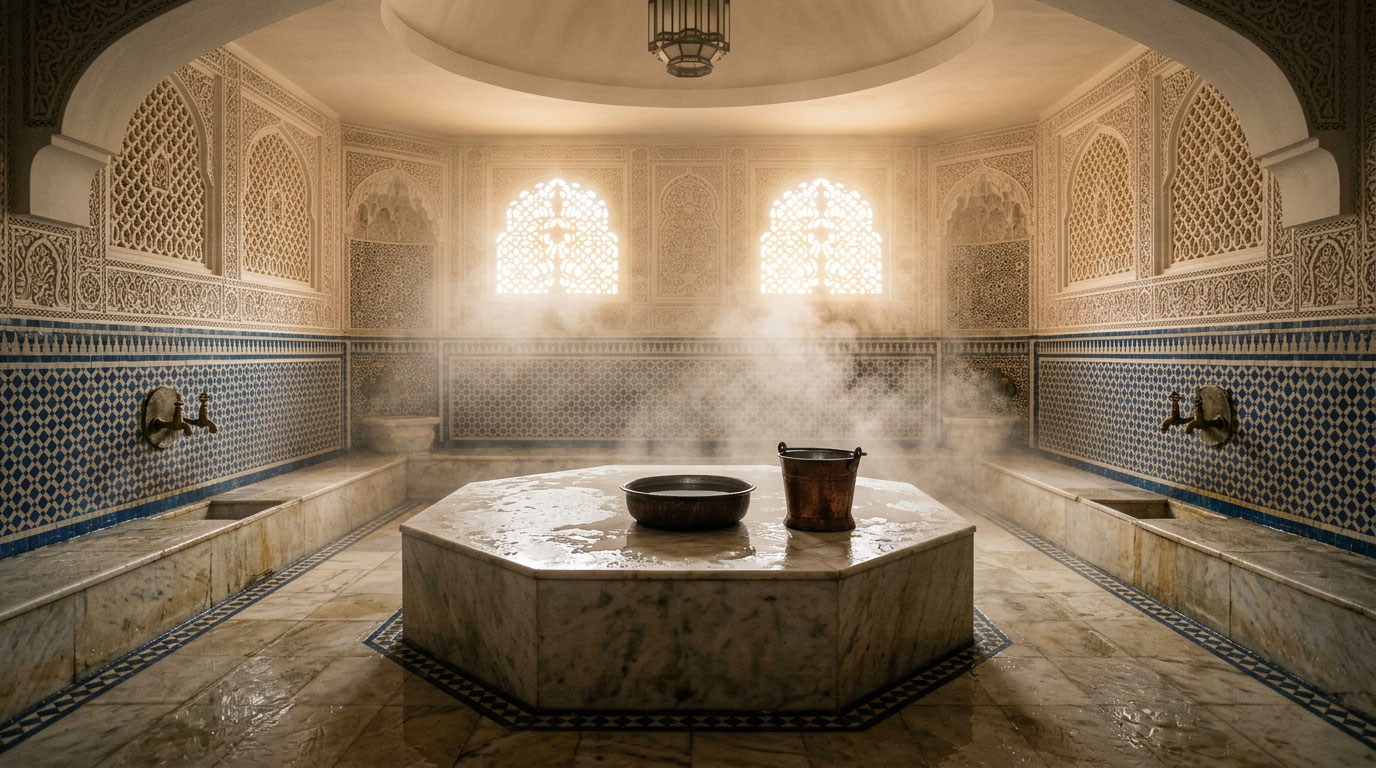
What is done and what is not
The fūṭa is worn at all times, from entrance to exit: the ʿawra remains covered throughout, from navel to knee, without exception and without dispensation. No one looks at, and no one touches, what the fūṭa covers.
The hammam is never mixed. The hours for men and those for women are strictly separate, as Maghrebi usage requires. No photograph is taken there, by residents or by guests.
These rules are not a modern precaution. They take up, without softening them, those that prophetic tradition and the Muslim jurists laid down for the bath from the earliest centuries:
مَنْ كَانَ يُؤْمِنُ بِاللَّهِ وَالْيَوْمِ الآخِرِ فَلاَ يَدْخُلِ الْحَمَّامَ إِلاَّ بِمِئْزَرٍ
“Let him who believes in God and the Last Day not enter the bath except with a waist-wrapper.”
Prophetic tradition — reported by al-Tirmidhī and al-Nasāʾī
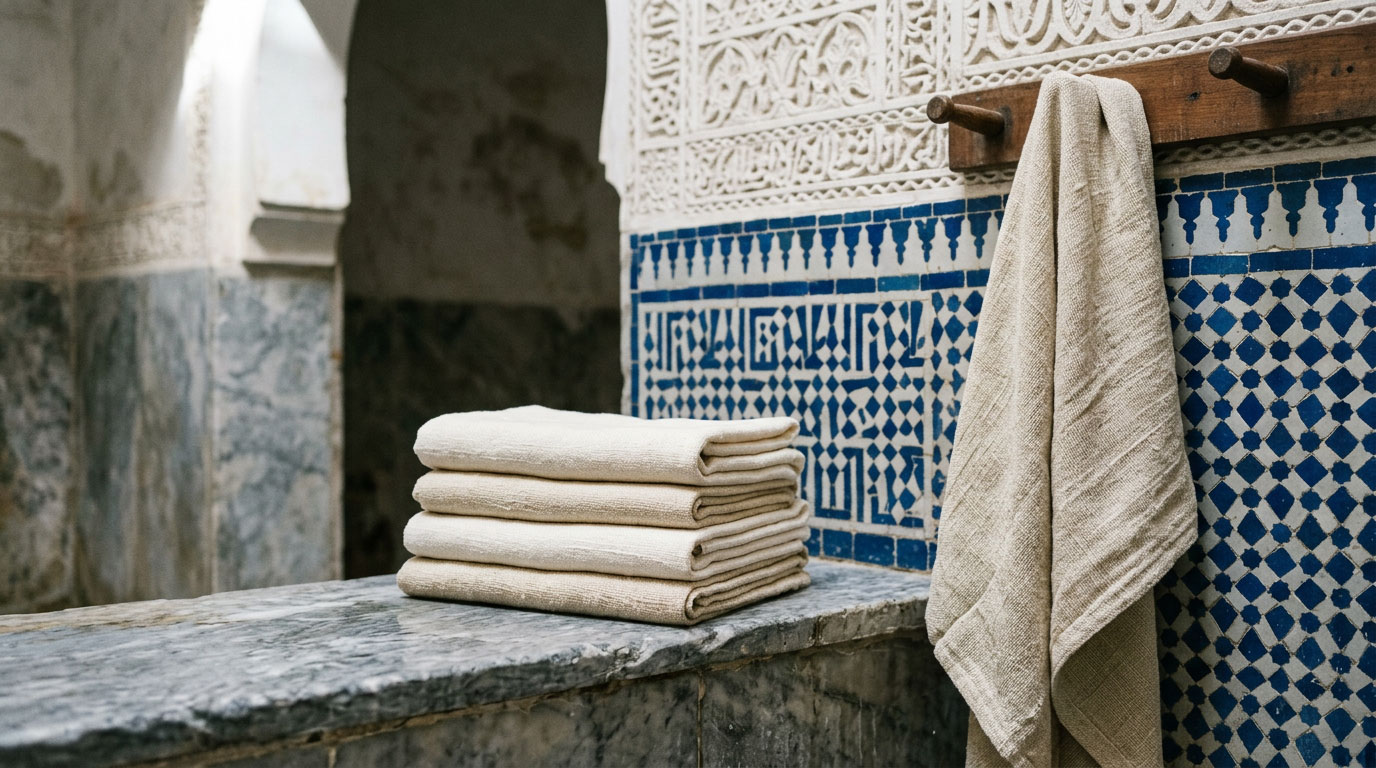
A Mediterranean history
The hammam was not born in the Islamic world: it inherits from it. Its roots lie in the Roman and Byzantine baths, which the emerging Muslim world adopted and transformed from the 8th century onward. In al-Andalus, from the end of that same century, the bath appears in residences and palaces before spreading through towns and countryside — carried by geographers who describe it, jurists who regulate its use, and physicians who praise its virtues.
مُتَفَرِّجُ الأَبْوابِ عَن صَحْنٍ ثَوى فيهِ الصَّباحُ وَشَرَّدَ الأَظلامُ
“Its doors open wide onto a courtyard where morning has settled and from which shadow has been put to flight.”
— Ibn Darrāj al-Qasṭallī, Andalusi poet (10th–11th c.), Waṣf al-ḥammām
A place the law regulates
The public bath does not enter Muslim life unexamined: it enters regulated. Jurists set its conditions very early — covering of the ʿawra, strict separation of the sexes, prohibition of the gaze — and al-Ghazālī devotes to the ādāb al-ḥammām, the proprieties of the bath, a passage of his Iḥyāʾ ʿulūm al-dīn. In al-Andalus, the ḥisba treatise of Ibn ʿAbdūn, written in Seville in the 12th century, goes so far as to govern who may work in the baths, and under what conditions of decency.
The hammam is thus one of the few places in the city whose use was, from the outset, set down in writing. It is that tradition, and not some present-day house policy, that the house applies.
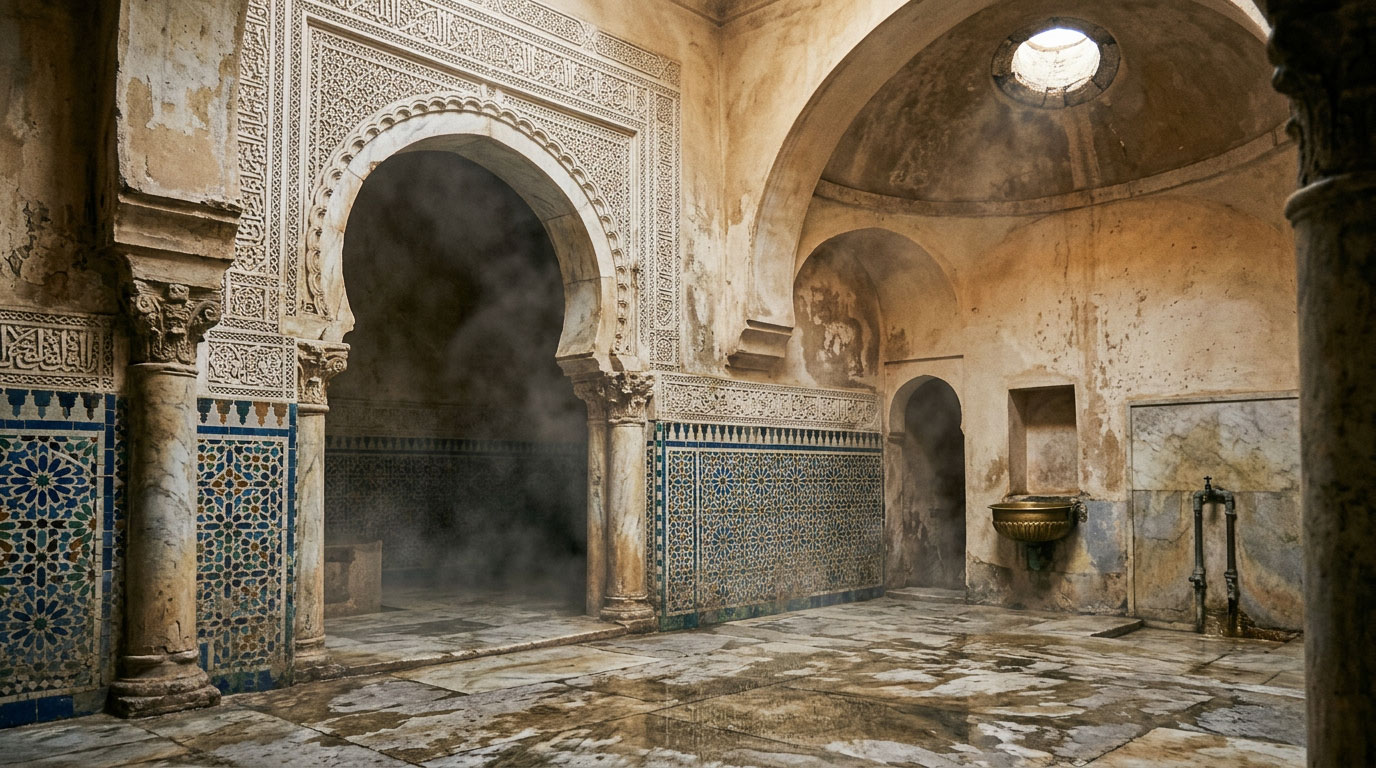
The rooms: a path, not a single space
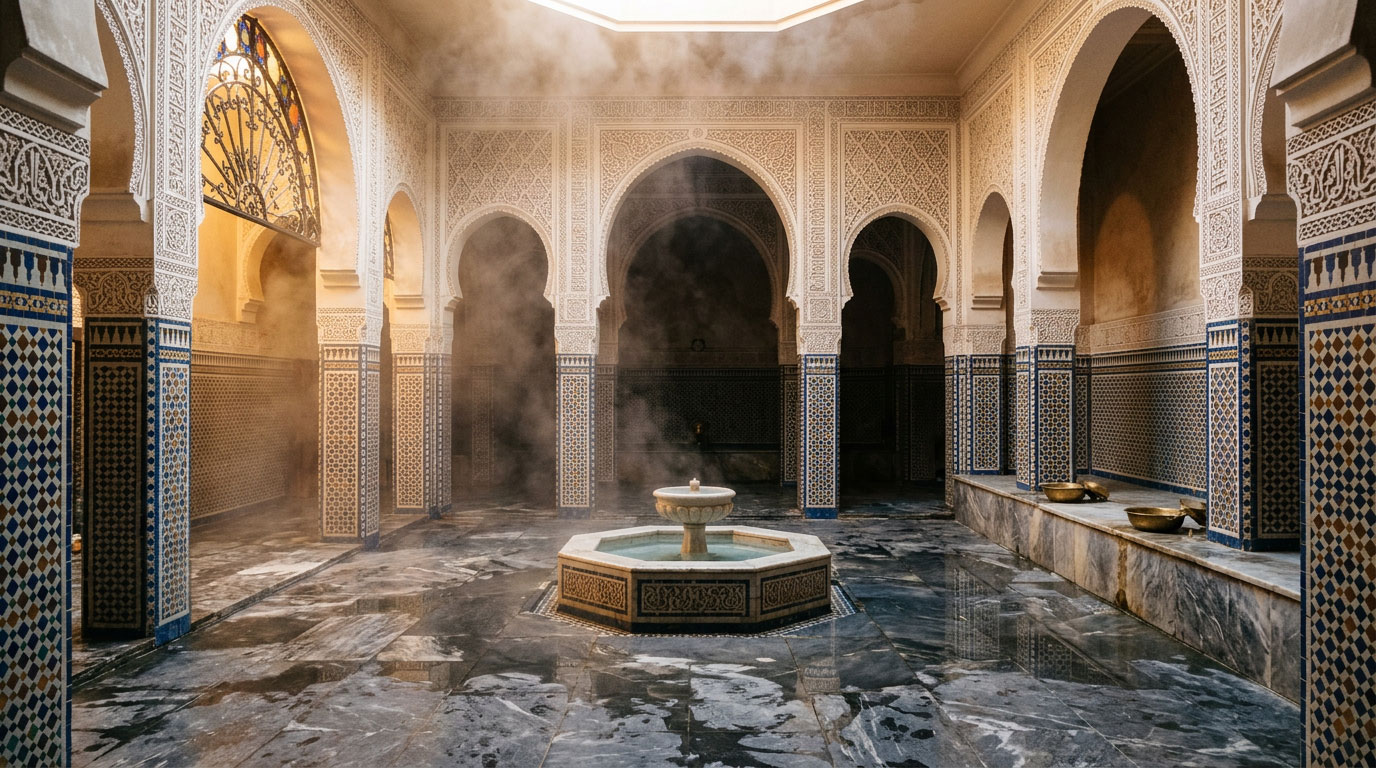
The traditional hammam is not a single room but a path through several rooms of rising, then falling, temperature — a principle found, sometimes under different names, from Andalusia to the Maghreb.
| Room | Arabic name | Roman name | Function |
|---|---|---|---|
| Changing room | المسلخ — al-maslakh | apodyterium | One leaves one's clothes here and ties the fūṭa before entering the path. |
| Cold room | البيت البارد — al-bayt al-bārid | frigidarium | The body acclimatises here on entry; one returns later to rest at length, over tea, once the bath is finished. |
| Warm room | البيت الوسطاني — al-bayt al-wastānī | tepidarium | The heart of the hammam: the largest room, where most time is spent, between light steam and perfumes. |
| Hot room | البيت السخون — al-bayt al-sukhūn | caldarium (or calidarium) | The most intense: the heat opens the pores and prepares the skin for the black soap, then the kessa glove. |
| Furnace | بيت النار — bayt al-nār | praefurnium | Invisible to bathers, behind the hot room: it feeds the whole system with heat. |
This organisation into rooms of rising temperature is not an Islamic invention: it directly continues that of the Roman baths. The correspondence, as can be seen, does not bear on one or two rooms but on the entire building — from the changing room where one undresses to the furnace chamber the bather never sees. The name changes language; the logic remains intact.
The kinship is all the clearer in that the heating method is inherited too: the heat of the praefurnium circulates beneath the floor and within the thickness of the walls, following the Roman principle of the hypocaustum, which the baths of al-Andalus and then of the Maghreb preserved unaltered.
In the hot room, the steam is most often scented with eucalyptus essential oil — sometimes combined with mint — diffused to clear the airways; argan oil and olive oil, by contrast, remain reserved for skin care, not for the steam.
The path is not linear: at the end, one returns to rest in the cold room. The hammam was never a quick errand, but an occasion that could last for hours.
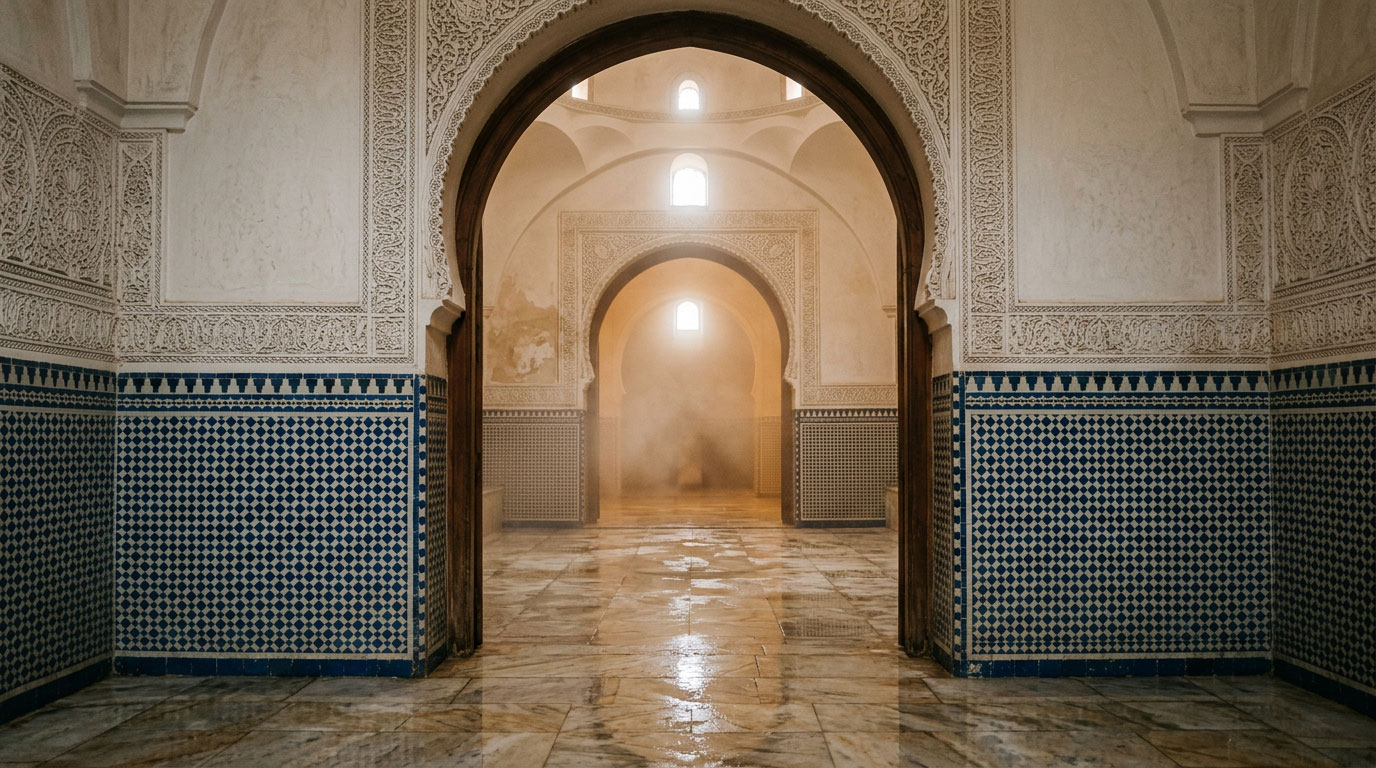
In Fez itself, the Hammam al-Mokhfiya — dated to the mid-14th century, under the reign of the Marinid sultan Abū ʿInān, adorned with carved stucco and zellige, and attached to the habous endowment of the Qarawiyyin mosque — bears witness to this same spatial organisation, just steps from what would one day become the Riad.
The göbek tasi — the heated stone
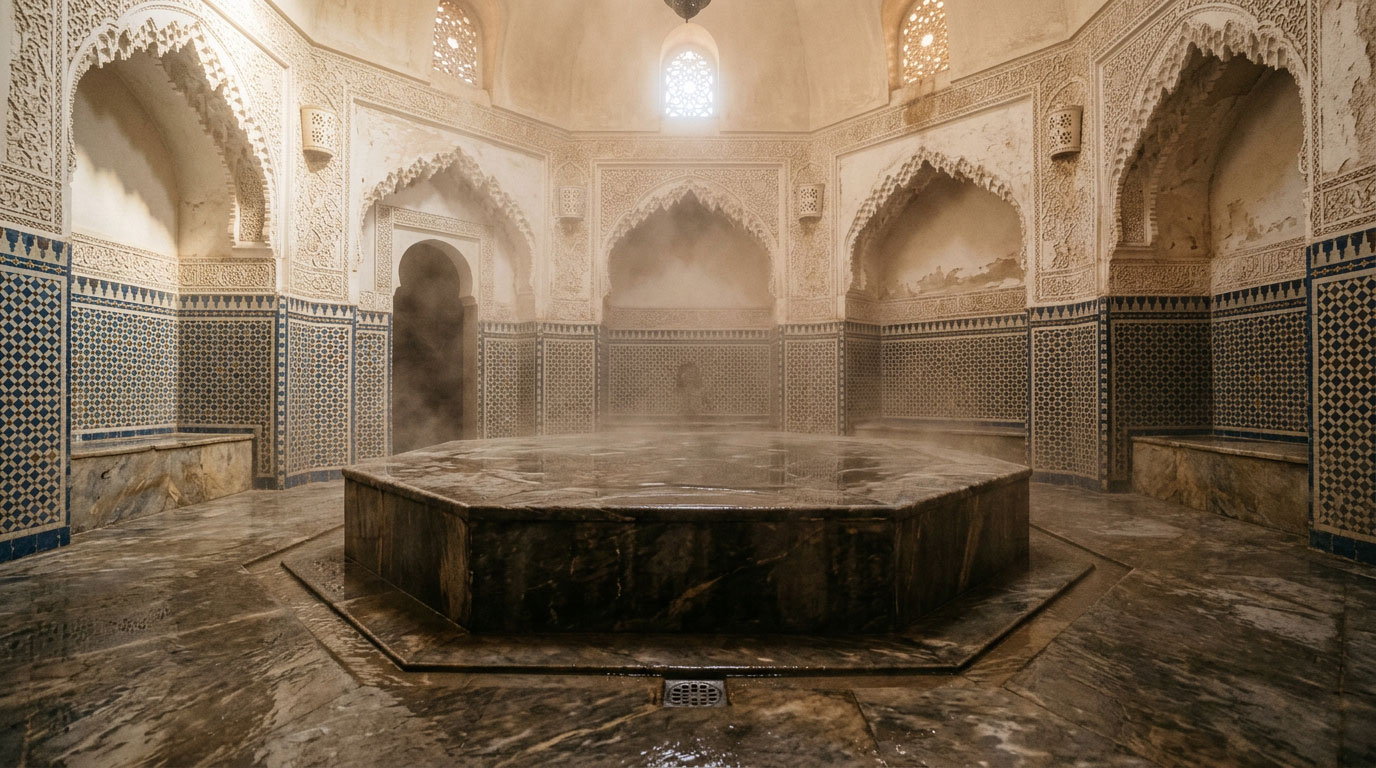
At the centre of the hot room, some hammams feature a wide marble platform heated from below — the göbek tasi (“navel stone”), on which one stretches out to sweat before the scrub. The element belongs first to the Ottoman hammam tradition, distinct from the Maghrebi and Andalusian tradition in which the Riad stands — but it is found today, through a blending of customs, in many contemporary Moroccan hammams, notably in Marrakech and Fez.
At the Riad, the choice remains faithful to the original Maghrebi logic: several rooms of rising temperature rather than a single central stone. The göbek tasi, where it exists, answers moreover to the same principle as the whole hammam — heat that prepares the body before any other gesture.
The ritual: three gestures, an ancient order
Black soap (sabun beldi)
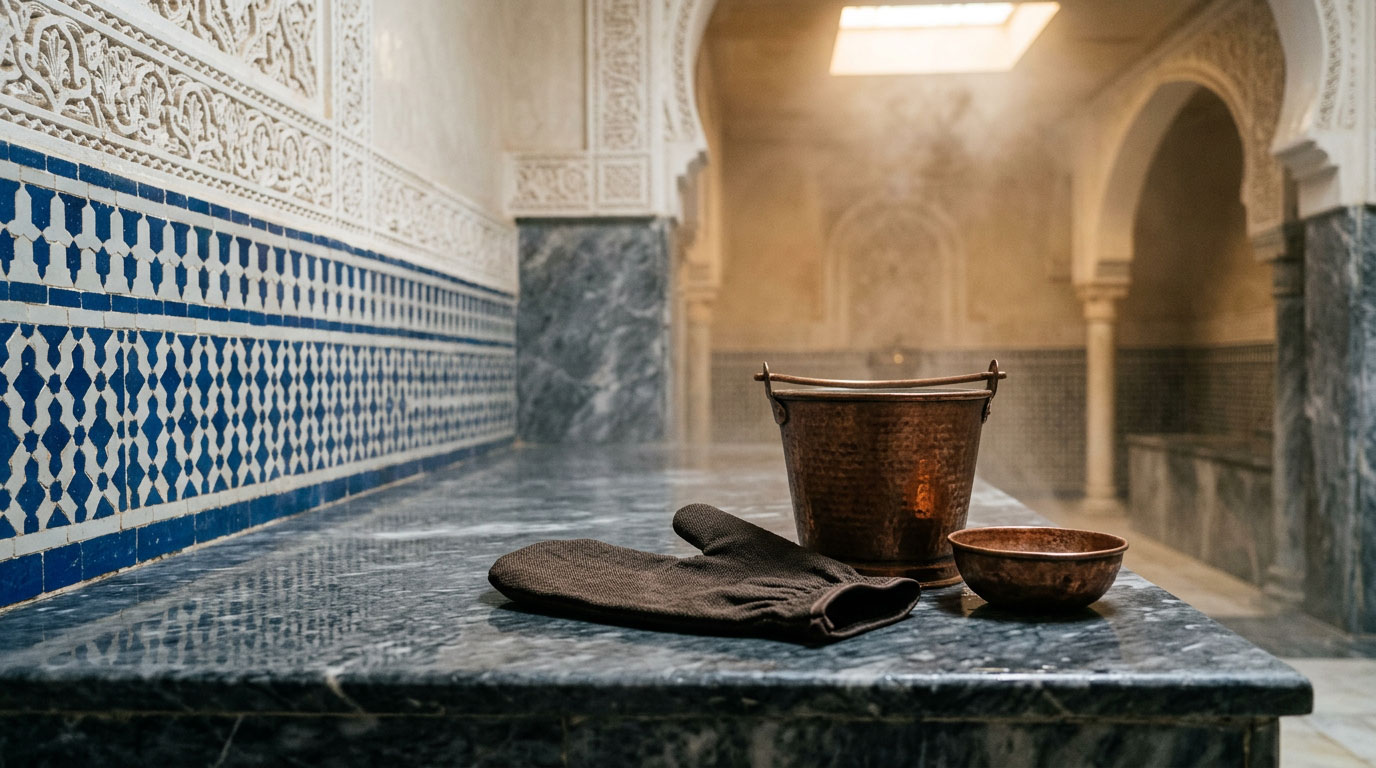
A dark olive-oil paste, sometimes enriched with crushed olives, historically linked to production centres such as Essaouira. Applied to warm, damp skin, it is left to sit for several minutes: it is this soap that softens deeply what the glove will then remove.
The kessa glove
Woven, deliberately rough, it exfoliates with firm but measured circular movements. This is not a violent gesture against the skin: it is a gesture of patience — the same spirit as that of the potter or the tanner, applied to the body rather than to raw material.
Ghassoul (or rhassoul)
A mineral clay extracted in the Atlas mountains, applied as a mask: it absorbs, tightens, purifies — without irritating the skin, unlike industrial soaps.
The ritual closes with a few drops of argan oil, to seal what the steam and the clay have opened.
These three gestures do not aim at pleasantness: they aim at ritual cleanliness. What the steam opens, the clay closes again, and the body becomes fit for prayer once more.
The tayeb — a craft of the hammam
In the traditional Maghrebi hammam, the man who performs the kneading is called the tayeb; his female counterpart, the tayyaba, works in the women's hammams. The two worlds remain strictly separate, through distinct rooms or hours.
This is not a spa profession trained in a school: it is a knowledge transmitted inside the hammam itself, through repetition — the same logic of transmission as that of the Dar al-Hiraf workshops, applied to the body rather than to raw material. The gesture, firm and brief, releases the tensions of manual work: a kneading of the muscles of the back and shoulders, within the limits the law sets for the bath.
This heritage is not unique to the Islamic world: the Roman and Byzantine baths already practised tractatio, the kneading with oil after bathing — a gesture that the hammam inherited and has passed on, in its own way, down to today.
The hammam and the jinn — a popular belief
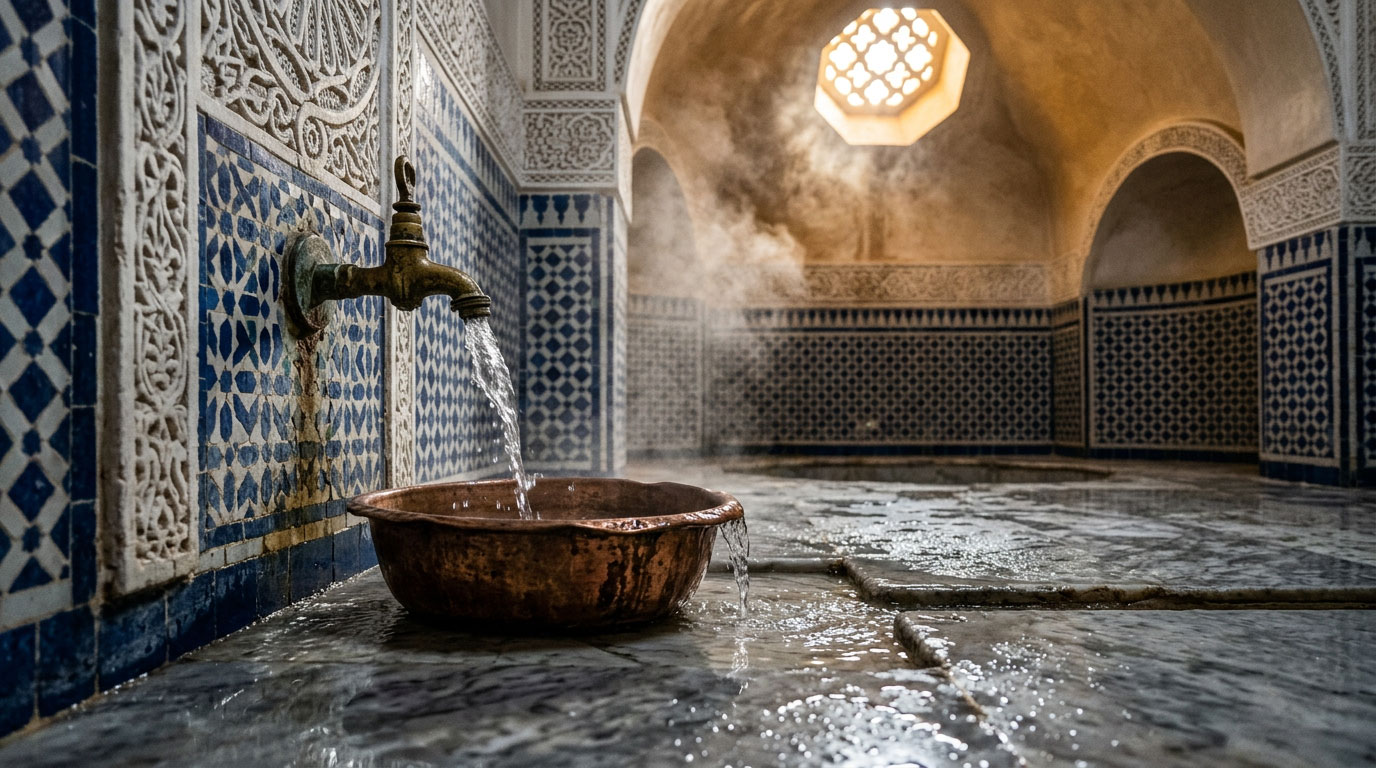
In Moroccan popular tradition, the hammam is said to be a place where the jinn — invisible beings mentioned in the Qur'an, made of smokeless fire — like to dwell. It is said that they favour damp, little-frequented places.
Hence a simple habit, still alive today: pronouncing the basmala before entering, as before any water room — a gesture that goes back to a prophetic tradition associating the formula with passage into places of ritual impurity, long before the popular belief about the jinn grafted itself onto it.
This tradition belongs to popular memory, not to the core of doctrine — one more example of how the sacred and the everyday remain, in Morocco, intimately intertwined.
The terms on this page are gathered in the glossary of the house.